.webp)

Physical climate risk is no longer theoretical. Years of advances in climate science and analytics have given organizations unprecedented visibility into where assets are exposed, how hazards are evolving, and which risks matter most.
That risk awareness has been essential. It underpins stronger governance, better disclosure, and more informed decision-making across industries.
But the business environment has shifted.
Today, exposure alone is no longer the question investors, boards, and regulators are asking.
The real question is how those risks are being managed—and whether capital is being deployed to protect value and build resilience.
Adaptation is now a capital planning imperative
Climate change is already reshaping business fundamentals. Insurance costs are rising, asset values are shifting, and scrutiny from investors and regulators is intensifying. In this environment, resilience can no longer sit outside financial planning.
It must be evaluated alongside other strategic investments—using the same financial logic.
When unmanaged risk erodes value, strategic adaptation preserves and grows it. The challenge is not recognizing the risk. It’s translating that understanding into defensible, investment-ready action.
That translation requires more than awareness. It requires decision-grade adaptation modeling that allows resilience measures to be evaluated like any other capital allocation: quantifiable, comparable, and defensible.
The gap between risk insight and capital action
Traditional climate risk outputs—hazard maps, exposure scores, and portfolio heatmaps—play a critical role in identifying vulnerability. They help organizations understand where risks concentrate and how those risks may evolve over time.
But they stop short of enabling decisions.
They don’t answer whether elevating equipment, installing flood barriers, retrofitting for wildfire, or redesigning cooling systems will meaningfully reduce loss. And they don’t quantify whether those investments make financial sense relative to other uses of capital.
As a result, adaptation is often treated as an engineering exercise, an ESG aspiration, or a future consideration—rather than what it truly is: A capital allocation decision.
Why adaptation modeling changes the equation
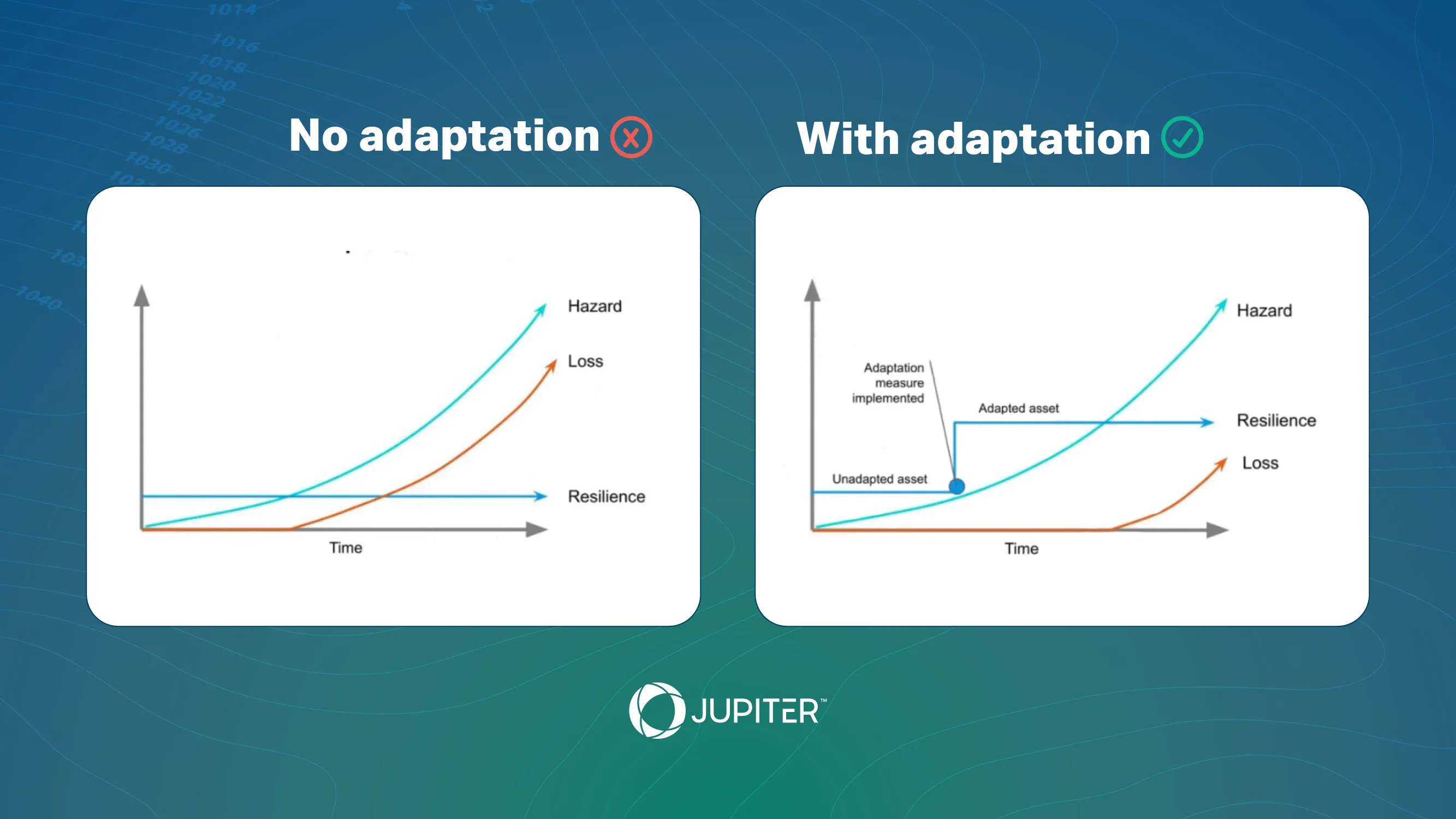
Adaptation modeling closes this gap by shifting the focus from identifying risk to evaluating solutions.
Instead of asking “How exposed is this asset?” adaptation modeling asks:
“Which resilience measures reduce loss most effectively—and do they justify the investment?”
By quantifying how specific interventions change damage outcomes and translating those reductions into financial terms, adaptation can be evaluated using the same logic applied to other investments. Costs, benefits, payback periods, and return on investment become measurable and comparable across assets and portfolios.
If unmanaged risk erodes capital, strategic adaptation preserves and grows it.
What “decision-grade” adaptation really means
Not all adaptation analysis is created equal. To support real capital decisions, adaptation modeling must go beyond high-level assumptions or generic resilience claims.
Decision-grade adaptation modeling requires:
- Site-specific analysis that reflects local hazards, asset characteristics, and realistic intervention options
- Transparent assumptions, including how costs are estimated and how adaptation effectiveness is modeled
- Financially relevant outputs, such as avoided loss, ROI, and payback periods—not just changes in risk scores
- Scenario-based comparisons that allow trade-offs to be evaluated across time horizons
Without these elements, adaptation remains difficult to justify, compare, or defend—particularly under regulatory, audit, or investment scrutiny.
Why this matters now
The business case for adaptation is no longer abstract.
Insurance markets are retreating from high-risk regions. Asset values are being recalibrated. Capital providers increasingly expect evidence that physical climate risk is being actively managed—not simply disclosed.
At the same time, supervisors are sharpening their focus on how climate risk translates into financial vulnerability. Organizations that cannot demonstrate how they plan to manage risk—not just measure it—face growing friction.
In this environment, the ability to quantify adaptation ROI is a competitive advantage. Institutions that can model, compare, and defend resilience investments move faster, allocate capital more confidently, and protect long-term value as repricing accelerates.
What the From Risk to Resilience eBook explores
The From Risk to Resilience eBook examines why adaptation modeling is becoming a core component of modern climate risk management. It explores:
- Why adaptation is now a capital planning imperative
- What separates theoretical resilience planning from decision-grade modeling
- How adaptation can be treated as an investable, finance-led activity
- What first movers gain by acting before physical risk is fully repriced
For organizations looking to move beyond exposure awareness and toward measurable action, adaptation modeling provides the missing link.
Moving forward
Climate risk analysis has matured rapidly. The next step is ensuring it leads to outcomes—not just insight.
Adaptation is no longer about knowing where risk exists. It’s about deciding what to do, where to invest, and how to defend those decisions with confidence.
Learn how adaptation modeling turns risk insight into capital action.
%20(1).webp)
