.webp)

ECB supervision is redefining climate risk as a core financial discipline. Banks must now demonstrate forward-looking, defensible analytics embedded in capital, governance, and strategy to meet rising supervisory expectations.
Climate risk is no longer a future consideration for European banks — it is a present supervisory expectation.
Over the past several years, the European Central Bank (ECB) has moved from principles-based guidance to active supervisory enforcement. Climate and nature-related risks are now treated as structural drivers of financial vulnerability, feeding directly into credit, market, operational, and liquidity risk assessments.
For banks operating in the euro area, the question is no longer whether climate risk matters. The question is whether they can demonstrate — with defensible evidence — that it is embedded in core risk management and capital processes.
Climate Risk Has Entered the Supervisory Core
The ECB’s 2026–2028 supervisory priorities make clear that climate risk is not a parallel reporting exercise — it is a financial risk that must be managed through existing prudential frameworks.
Supervisors now assess climate risk through:
- Supervisory Review and Evaluation Process (SREP) outcomes
- Balance-sheet resilience assessments
- Remediation plans and follow-up reviews
- Capital and liquidity judgments where uncertainty remains high
This shift marks a turning point. Climate risk capabilities are no longer judged on intent, but on execution.
Climate risk is no longer a disclosure exercise — it is a core financial discipline under active supervisory scrutiny.
What Supervisors Expect Banks to Demonstrate
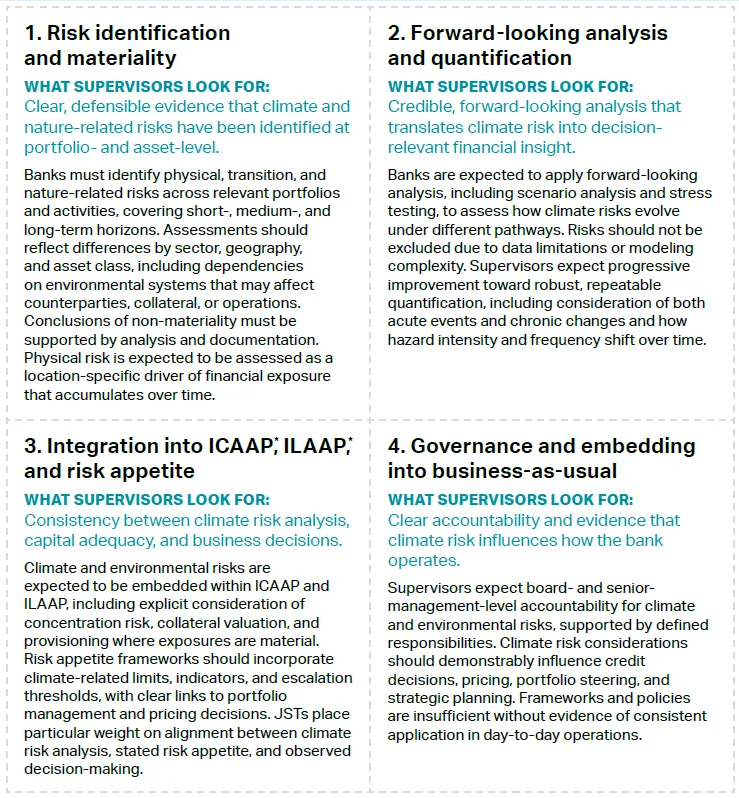
ECB Joint Supervisory Teams assess climate risk management across four closely linked pillars: identification, quantification, integration, and governance.
1. Risk Identification and Materiality
Banks must provide clear, defensible evidence that physical, transition, and nature-related risks are identified across portfolios and assets, differentiated by geography, sector, and time horizon.
2. Forward-Looking Analysis and Quantification
Supervisors expect credible scenario analysis and stress testing that translate climate risk into decision-relevant financial insight — even where data limitations exist.
3. Integration into ICAAP, ILAAP, and Risk Appetite
Climate risk must be embedded in capital adequacy, liquidity assessments, collateral valuation, and portfolio management decisions.
4. Governance and Business Integration
Boards and senior management must demonstrate accountability, with evidence that climate risk influences credit decisions, pricing, and strategy.
Taken together, these expectations signal a clear supervisory message: climate risk must function as a financial risk discipline, not a disclosure exercise.
What “Good” Looks Like Under ECB Scrutiny
Banks that meet supervisory expectations share several characteristics:
- Portfolio- and asset-level visibility into physical risk
- Forward-looking scenarios aligned with business planning
- Direct links between climate outputs and capital decisions
- Transparent, defensible methodologies able to withstand audit
This combination demonstrates that climate risk is embedded in core processes — and reduces the likelihood of heightened supervisory scrutiny or conservative capital treatment.
Transparent, forward-looking climate analytics are now essential for credible supervisory dialogue and defensible capital decisions.
The Risk of Falling Behind
Where banks cannot demonstrate robust climate risk management, supervisors may respond with:
- Remediation plans
- Increased supervisory intensity
- Conservative capital and liquidity judgments
Recent ECB enforcement actions show that these expectations now carry direct financial consequences. In February 2026, the ECB imposed €7.55 million in periodic penalty payments on Crédit Agricole for failing to complete required climate risk materiality assessments on time, following earlier fines against other institutions for delayed risk identification and compliance gaps.
In this environment, gaps in climate risk capability translate directly into supervisory and financial exposure.
From Compliance to Confidence
While ECB supervision raises the bar, it also provides clarity. Banks that invest in forward-looking, decision-grade climate analytics gain more than compliance — they gain defensibility.
Robust physical risk analysis enables institutions to:
- Quantify concentration risk by geography, sector, and hazard
- Align climate scenarios with strategic and capital planning
- Strengthen supervisory dialogue with transparent methodologies
In short, strong climate risk capabilities support better decisions — and stronger trust with regulators.
Turning Expectations into Execution
Banks don’t need to start from scratch. With decision-grade physical climate risk analytics, institutions can translate exposure into financially relevant metrics, align scenarios with capital planning, and demonstrate defensible methodologies under supervisory scrutiny — turning compliance pressure into strategic confidence.
Why This Matters Now
European supervision is setting a global precedent. As climate risk becomes embedded in prudential frameworks worldwide, the ECB’s approach signals where supervisory expectations are heading.
Banks that act now will be better positioned to:
- Navigate supervisory scrutiny with confidence
- Defend capital and portfolio decisions
- Move from reactive compliance to proactive resilience
Climate risk supervision is no longer about future readiness. It is about present credibility.
Download the ECB Climate Supervision eBrief
Understand what supervisors expect today — and how to demonstrate readiness.