.webp)

Not all climate risk data is created equal. As physical risk becomes capital risk, institutions need transparent, defensible, decision-grade analytics that can withstand scrutiny from regulators, auditors, and investment committees.
Physical climate risk has moved from the sustainability report to the balance sheet.
It now shapes how assets are valued, how credit is priced, how insurance is structured, and how infrastructure is designed. But as demand for climate data has surged, so has the number of providers offering dashboards, scores, and maps that look similar on the surface — while differing dramatically under the hood.
That difference is no longer academic. It’s financially material.
Weak data can lead to mispriced risk, stranded assets, failed audits, and regulatory exposure. Strong data enables confident capital allocation, defensible disclosures, and actionable adaptation strategy.
The Hidden Risk in “Good-Looking” Climate Data
A polished interface can mask serious flaws:
- Missing perils
- Single-model projections with no uncertainty ranges
- Coarse outputs that don’t translate to asset-level decisions
- Opaque methodologies that cannot be defended to Model Risk Management (MRM)
These issues rarely surface during procurement. They appear later — during stress testing, audit review, or when a real-world event exposes a gap between modeled risk and actual loss.
If you can’t explain how the data was generated, you can’t justify the decisions it informs.
In regulated environments, that’s not just a technical problem. It’s a governance failure.
Climate Risk Data Is Capital Risk Data
Physical risk analytics now feed directly into:
- Loan-to-value and probability of default models
- Insurance pricing and coverage decisions
- Portfolio stress testing
- Long-term infrastructure planning
That means the quality of the underlying science determines the quality of the financial outcome.
Single-point estimates, black-box scores, or limited time horizons create false confidence — especially for long-lived assets that extend well beyond 2050.
When assumptions don’t hold up, neither do the capital decisions built on them.
Decision-makers don’t need more climate data. They need defensible data.
A Framework for Evaluating Climate Risk Vendors
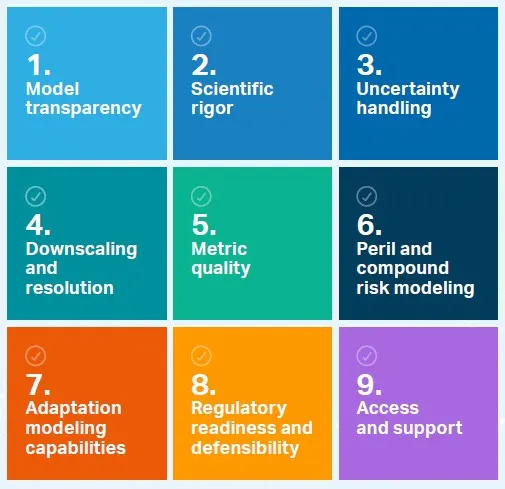
The Buyer’s Guide introduces a nine-point framework to help institutions distinguish foundational data from decision-grade analytics.
At its core, the framework asks whether a provider can deliver:
- Model transparency — documented assumptions, bias correction, and scenario logic
- Scientific rigor — peer-reviewed methods validated against observed events
- Quantified uncertainty — probabilistic outputs, not single-point scores
- Defensible downscaling — asset-level resolution grounded in physical science
- Finance-aligned metrics — expected loss, LTV, PD/LGD, and climate-adjusted value
- Multi-peril modeling — realistic compound hazard scenarios
- Adaptation analytics — avoided loss and ROI from resilience investments
- Regulatory readiness — MRM-aligned, audit-ready documentation
- Access to experts — scientists who can support validation and implementation
From Risk Visibility to Adaptation Strategy
One of the most important shifts in the market is the move beyond static risk identification toward adaptation modeling and ROI analysis.
Institutions are no longer asking only:
Where is my risk?
They are asking:
- What happens to asset value if I invest in resilience?
- Which interventions reduce expected loss?
- How does adaptation change credit performance?
Decision-grade analytics quantify avoided loss, implementation cost, and payback period — enabling adaptation to be treated as an investment decision, not an engineering afterthought.
Risk visibility is only half the equation. The real value comes from showing how risk changes with action.
This is where climate risk analytics becomes climate strategy.
Your Model Is Your Strategy
Every physical risk model embeds assumptions about the future.
Those assumptions shape:
- Which assets are financed
- Which projects move forward
- How portfolios are rebalanced
- How institutions defend their decisions to regulators and investors
In that sense, your model is your strategy.
Firms that demand transparency, quantify uncertainty, and integrate adaptation into financial planning are positioning themselves to act earlier — while climate-resilient assets are still available at scale.
Trust + MRM + Decision-Grade
Jupiter has helped define what decision-grade climate intelligence looks like by working with some of the world’s most regulated financial institutions. Our models have passed rigorous Model Risk Management reviews, with fully documented methodologies, validated assumptions, and audit-ready outputs.
ClimateScore Global delivers:
- 22,000+ peril and loss metrics
- Multi-scenario analysis to 2100
- Finance-aligned outputs for credit, portfolio, and operational risk
- Adaptation ROI modeling to support capital planning
Combined with the MRM Accelerator and Adaptation Hub, institutions can move from exposure analysis to defensible execution — faster.
Download the Buyer’s Guide
Not all climate risk data is created equal.
The difference between “close enough” and decision-grade may not be visible at first — but it matters when capital is at stake.
Download the Buyer’s Guide to Evaluating Physical Climate Risk Data to see the full nine-point framework and assess whether your current analytics can withstand regulatory, financial, and real-world stress.
.webp)
