


Amazon, Microsoft, Alphabet and Meta alone guided to more than $700 billion of capital spending for 2026, most of it for data centers and the equipment inside them. A growing share of the money comes from capital markets: according to Barclays Research, outstanding data-center securitizations grew from $4 billion in 2020 to about $61 billion by mid-2026.
That capital is tied to buildings that cannot move, many of them in floodplains, on hurricane coasts or in hot, water-stressed regions. Yet natural hazards play almost no explicit role in how data-center securitizations are structured and rated.
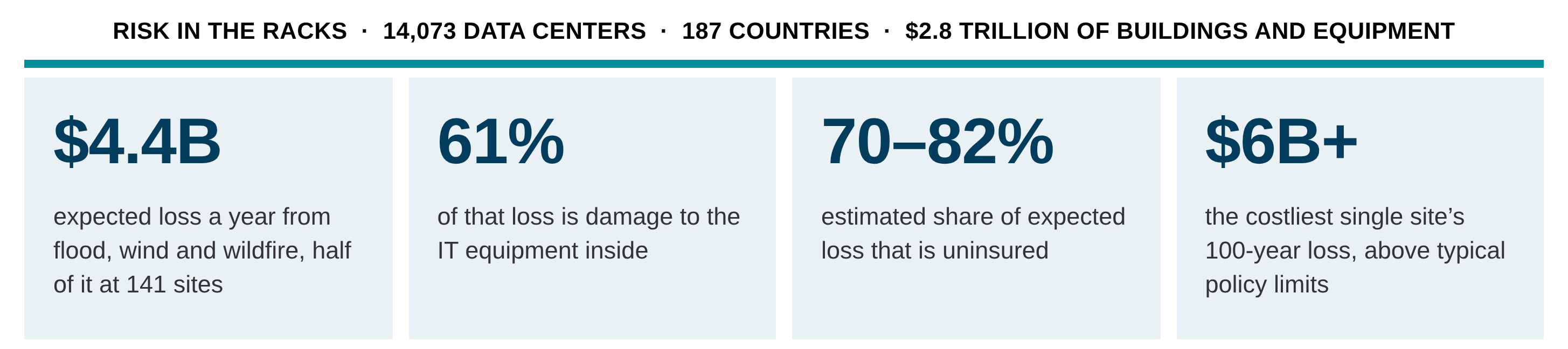
Risk in the Racks, new research from Jupiter Intelligence, goes beyond mapping where the hazards are. It estimates the dollar loss at each of 14,073 operating data centers in 187 countries, with $2.8 trillion of buildings and equipment at replacement cost, and follows each loss to the owners, tenants, insurers and lenders who would bear it.
Expected losses from flood, wind and wildfire already total $4.4 billion a year, 19% more than the same buildings would lose in the 1995 climate, and half of that sits at just 141 sites. Convective storms, hail and grid failures are outside the model, so on that count the total is a lower bound.
Capitalized, the climate cost comes to 3–4% of building and equipment value, several times more in the most exposed markets, and most of it reflects hazard that exists today, not future warming.
What matters for lenders, insurers and investors is where the risk sits, who carries it and when it arrives.
The risk is in the racks
Damage to servers, storage and GPUs accounts for 61% of expected loss and 74% of flood loss. That equipment is worth $1.78 trillion, about 70% more than the buildings and plant around it.
At colocation facilities, that equipment belongs to the tenants, not to the landlord whose building is insured, rated and securitized. Colocation tenants bear 24% of global expected loss, more than the 17% borne by their landlords, with little recourse under standard contracts. Their 1-in-100-year loss, $5.8 billion, is three times their landlords’ $1.9 billion.
Who pays: most of the loss is uninsured
An estimated 70–82% of expected loss, or $3.1–3.6 billion a year, is uninsured: by choice at the largest operators, which self-insure, and by necessity where coverage is scarce. The gap is widest where the loss is largest. China carries half of global expected loss on 17% of the value, and Swiss Re estimates that only about a tenth of natural-catastrophe losses there are insured.
For insurers, much of the exposure sits in tenants’ equipment covers rather than landlords’ property programs. The tail is local: within a single hub, the 1-in-100-year loss is typically 35–97% of the sum of its sites’ own 100-year losses, against 11% for a global portfolio. The costliest single site’s 100-year loss tops $6 billion, above the $1.5–3.5 billion policy limits that Engineering News-Record reports as typical for very large data centers.
Who lends: concentration and insurance terms drive credit risk
In Jupiter’s stress tests, modeled pools spread across many markets hold up; the risk sits in single-market pools in exposed hubs. Uninsured five-site pools in Shanghai, São Paulo and Hong Kong breach their cash-trap triggers in about 4–6% of years today: up to a one-in-four chance of at least one breach over a five-year note. Pools in Miami, Houston and New York–New Jersey breach in about 0.5–1.5% of years.
Insurance terms decide the outcome. With a 2% deductible, even the most exposed pools almost never breach; at 5%, the median São Paulo pool still breaches in 3.5% of years. Yet hub concentration, insurance terms and flood design rarely appear in rating methodologies or presale reports.
The horizons do not match. Data-center notes typically target repayment within about five years, while in both the middle-of-the-road and high-emissions scenarios most of the rise in climate cost comes after 2050. That later cost falls on equity holders, long-term lessees and insurers, and on lenders at each refinancing.
Who fixes it: elevation works, but landlords keep only a fifth of the gain
Raising the lowest floor at flood-exposed sites to the 100-year flood level would cut expected flood loss by 42% and total expected loss by 23%. In new construction, it pays for itself at sites holding 84% of the affected building value.
At third-party facilities, though, the landlord would bear the cost but keep only 22% of the benefit; the rest protects the tenants’ equipment. Cost-sharing leases and equipment insurance priced by floor height would help align the incentives.
Inside the full report

ABOUT THE RESEARCH
Risk in the Racks summarizes a working paper by the author. It combines Veridion’s global data-center facility data with site-level hazard and loss estimates from Jupiter’s ClimateScore Global, under three climate scenarios (SSP1-2.6, SSP2-4.5 and SSP5-8.5) from a 1995 baseline to 2100. Figures refer to today’s climate unless a scenario or year is given.
Wahib Ghazni, PhD, is Head of Economic and Financial Modeling at Jupiter Intelligence.
