.webp)

By Cushman & Wakefield and Jupiter Intelligence
Climate risk is no longer a distant or abstract concern. Across global real estate markets, its impacts are already being felt; through rising insurance premiums, operational disruptions, asset devaluation, and increasing capital costs. From more frequent flooding and wildfire exposure to intensifying heat stress, physical climate risks are reshaping how real estate is designed, valued, and managed.
At the same time, climate risk reporting is becoming more formalised through country-based regulation and voluntary global disclosure frameworks such as GRESB. With the 2026 GRESB reporting cycle now complete, many investors have met their immediate disclosure requirements. The real question is: how do you turn climate risk into better decisions, and stronger returns?
How do organisations move beyond reporting obligations and embed climate risk assessment and resilience planning into portfolio-wide decision-making?
Bringing Climate Risk into the Boardroom
Climate risk has moved from the margins into core business strategy.
Until recently, climate risk was a niche topic typically confined to sustainability teams and rarely integrated into core business decisions. Today, it is firmly a boardroom issue. This shift has been driven in part by regulatory pressure and investor expectations. More importantly, it reflects the tangible impacts now being observed across the built environment. Extreme weather events are influencing asset design, disrupting operations, increasing maintenance costs, and driving volatility in insurance markets. As a result, climate risk is no longer theoretical; it is a material business risk with direct financial consequences. The shift is clear: if it affects performance, it belongs in the boardroom.
Moving Beyond Compliance – Unlocking Competitive Advantage
Leading organisations are responding by reframing climate risk not as a reporting obligation, but as a source of competitive advantage.
Rather than treating climate risk analysis as a tick-box exercise, they are embedding it into enterprise risk management frameworks and using it to inform capital allocation decisions. Climate risk is evaluated alongside other core business considerations such as interest rates, foreign exchange, construction and materials costs, operational risk, and market dynamics.
This shift enables more informed decision-making across key areas, including capital planning, asset upgrades, and portfolio composition. In doing so, organisations are not only reducing exposure to climate-related disruptions, they are identifying opportunities to enhance resilience, improve asset performance, and protect long-term value.
The advantage comes from acting on the insight, not just reporting it and here’s how:
Putting Climate Risk Analysis into Action
Organisations that lead on climate risk do one thing differently: they apply it to real decisions.
Three areas matter most: acquisitions, design, and operations.
1. Acquisitions: Reducing Uncertainty at the Point of Investment
Every real estate decision involves risk - climate risk analysis simply makes that risk more visible and measurable.
The goal is not to eliminate risk, but to understand it well enough to price, manage, and act on it. The earlier climate risk is factored into investment decisions, the greater the value it protects and creates.
For shorter-term or expedited decisions, flexibility may be limited. For example, a lease in a higher-risk location may still be necessary due to operational priorities. In these cases, understanding relative risk across available options can still inform better site selection and adaptation planning.
However, the importance of climate risk increases significantly for long-term or capital-intensive assets. Consider a data centre: a high-value asset that can take years to develop and is expected to operate for decades amid rapid innovation regarding its efficiency and resilience. In these scenarios, investing time upfront to select lower-risk sites, and designing assets to withstand future conditions can materially improve long-term reliability, operational continuity, and financial returns.
Leading organisations embed climate risk into their acquisition criteria from the outset, using it to guide deal selection and structure. By doing so, they reduce uncertainty and enhance the resilience of their investments over time.
2. Design: Building for Tomorrow, Not Today
Design decisions made today will shape asset performance for decades. Yet many traditional design approaches rely on historical climate patterns, which are no longer a reliable guide for the future.
Forward-looking organisations are adopting a different approach: designing assets to perform under future climate scenarios requiring different ranges of stress testing concepts, not just current conditions.
This includes rethinking elements such as cooling capacity, insulation standards, flood resilience, and fire protection. In some cases, it may mean exceeding minimum regulatory or planning requirements to ensure assets remain fit for purpose over their full lifecycle.
While these decisions may impact upfront costs, they often reduce the need for costly retrofits or even avoiding total losses after a disastrous event, and act as a buffer against the worst aspects of climate impacts. Insurance is another key factor: a well-designed asset in an at-risk location represents a lower insurance risk than a standard asset in the same place. In many cases, insurers have even started tying insurance conditions for data centres to a well-mapped resilience analysis or adaptation plan.
Smart designs help future-proof assets, positioning them to deliver stronger performance, lower operational risk, and sustained market relevance in a changing environment.
In a market where resilience is increasingly valued, design becomes a key differentiator.
Let’s look at the Hyperion Data Center in Richland Parish, Louisiana, in the U.S. - a joint venture between Meta and Blue Owl Capital, set to be completed by 2030. The facility is slated to draw up to 5 GW of electricity when fully completed by 2030. To service this, Entergy Louisiana is constructing 10 dedicated natural gas-fired power plants (costing roughly $11 billion) and will bundle in 240 miles of transmission lines and battery storage.
Upon a first screening for climate hazard exposure at the site, several hazards are immediately flagged as medium to high exposure: flood, drought, heat and extreme precipitation, with average flood levels set to increase by around 16% until 2050:
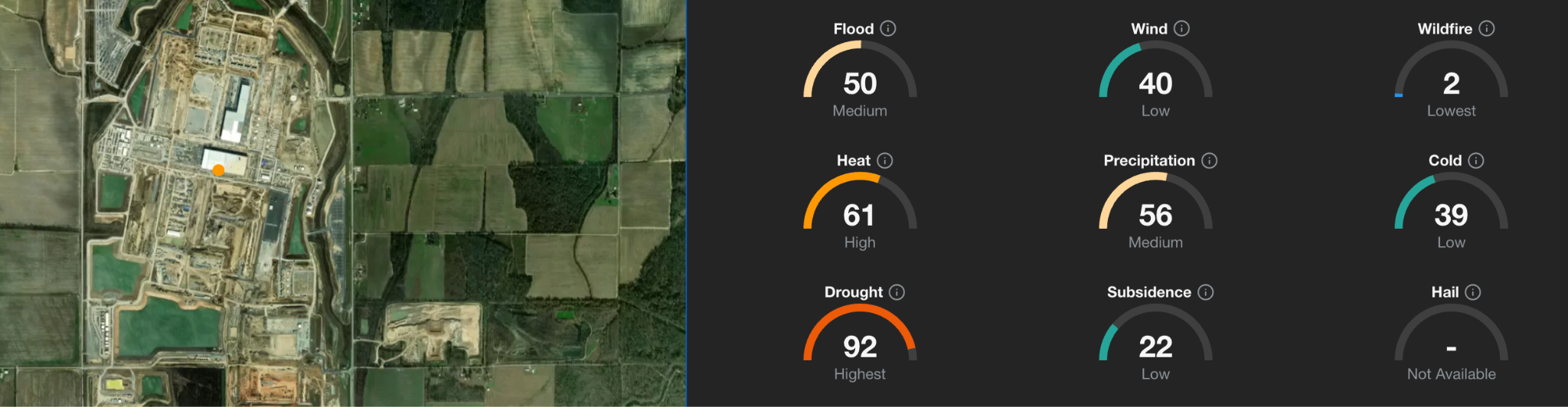
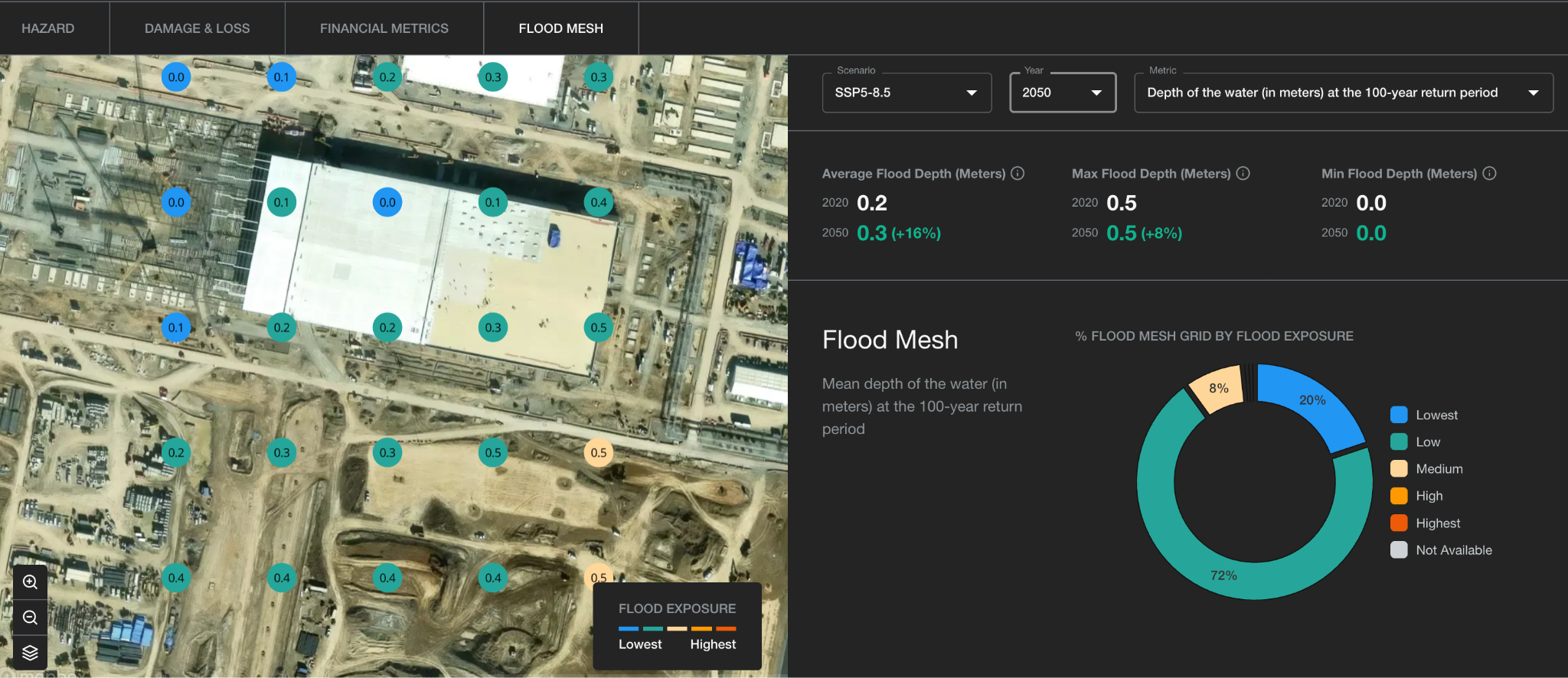
This is a good example of how even a screening level exercise on climate hazard exposure at the site directly can reveal how a conversation with site-planning resilience experts is needed, to ensure these hazards do not lead to escalating costs over the lifetime of the data centre. A further analysis should be conducted to understand vulnerabilities along energy supply chains or transportation infrastructure dependencies.
3. Operations: Managing Risk Across Existing Portfolios
For many organisations, the greatest exposure lies not in new developments, which climate risk management is maturing, but in existing assets, particularly those developed without consideration of climate risk.
These assets are already being affected by climate-related impacts and require a proactive approach to risk management.
Advanced climate analytics now make it possible to rapidly assess and compare risks across entire portfolios. Organisations can identify high-exposure assets, quantify potential financial impacts, and prioritise interventions based on risk severity and business importance.
From there, decisions can be made on appropriate responses. In some cases, targeted upgrades such as improved drainage, cooling systems, or physical protections may be sufficient. In others, more fundamental actions may be required, including major capital investment, repositioning, or even disposal.
Under a high-emission scenario, flood impacts on the Hyperion data centre's building, contents, and inventory are projected to cause severe disruptions by 2050. Even high-level economic assumptions based on asset type and vulnerability show that these impacts will drive up both capital expenses and operating revenue by more than 120%..
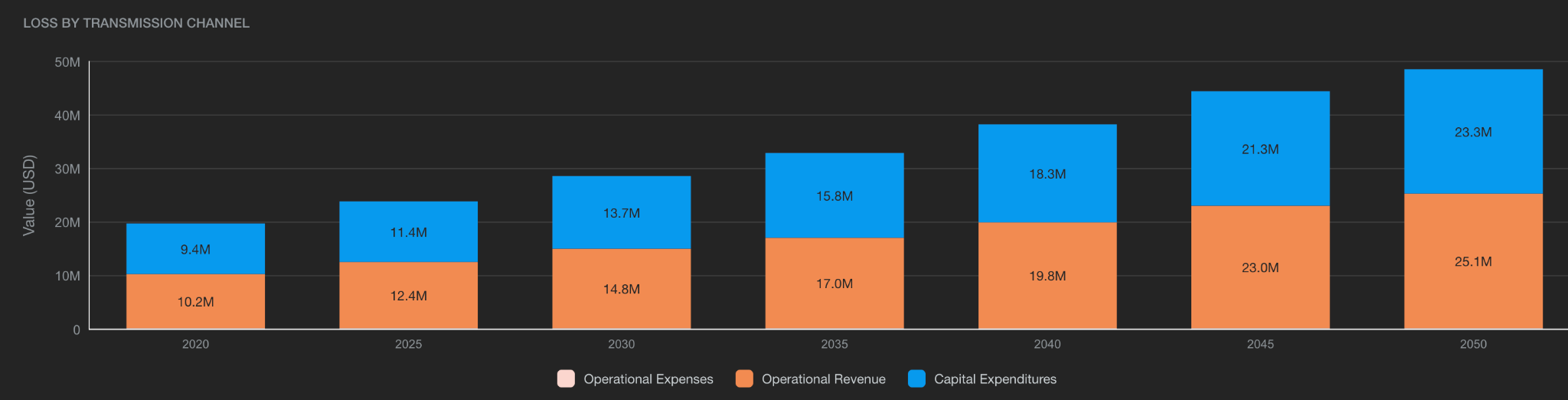
This example is a stark reminder that these decisions require long-term planning and resilience foresight. Relocating operations, upgrading infrastructure, or reshaping a portfolio cannot be achieved overnight. A structured, forward-looking approach allows organisations to act early, manage costs, and minimise disruption.
Effective operational climate risk management is therefore not a one-time exercise. It is an ongoing process that evolves alongside both the assets and the risks themselves – and alongside wider enterprise risk management frameworks.
Navigating Complexity with Confidence
Climate risk remains an evolving discipline. Regulatory frameworks are still developing, creating a “patchwork quilt” of compliance globally. Climate risk management methodologies are not yet fully standardised, and many organisations are at different stages of maturity. This creates both complexity and inconsistency across the market.
However, it also creates opportunity. Organisations that move beyond compliance and take a proactive approach to climate risk are better positioned to navigate uncertainty and most importantly, ensure competitiveness and safeguard capital investments. By embedding climate intelligence into decision-making, they can reduce costs, avoid disruption, and enhance the long-term resilience of their portfolios.
The most effective organisations do not seek to eliminate risk altogether. Instead, they understand it, manage it, and use it to inform better decisions.
In doing so, they turn climate risk into a source of strategic advantage – positioning their real estate portfolios to deliver stronger, more resilient returns in an increasingly uncertain world.
About Cushman & Wakefield
Cushman & Wakefield
(NYSE: CWK) is a leading global commercial real estate services firm for occupiers and investors with approximately 53,000 employees in over 350 offices and nearly 60 countries. In 2025, the firm reported revenue of $10.3 billion across its core service lines of Services, Leasing, Capital markets, and Valuation and other. Built around the belief that Better never settles, the firm receives numerous industry and business accolades for its award-winning culture. Contact us here.
Stephanie Greene
Chief Sustainability Officer & Head of Sustainability Services, Americas, Cushman & Wakefield
Matt Clifford
Head of Sustainability Services, APAC, Cushman & Wakefield
James Woodhead
Head of Sustainability Services, EMEA. Cushman & Wakefield
About Jupiter Intelligence
Jupiter Intelligence equips leading organizations to translate extreme weather risk into strategic advantage — quantified, benchmarked, and integrated into core operations. Our transparent, scenario-based analytics integrate seamlessly into capital planning, operational strategy, and adaptation investments, helping decision-makers act with confidence on science that stands up to scrutiny and defend every decision to boards, regulators, and stakeholders. Contact us here.
Elisa Seith
Director of Climate Risk and Financial Services, Jupiter Intelligence
