.webp)
.jpg)
When organizations begin incorporating physical climate risk into their decision-making, a seductive simplification often takes hold: find the "most likely" emissions scenario, run your analysis against it, and move on. It feels rigorous. It feels defensible. And it is, unfortunately, a methodological trap.
The Coupled Model Intercomparison Projects - CMIP5, CMIP6, and now the emerging CMIP7 - have given risk practitioners an extraordinary scientific resource. But understanding what these frameworks were actually built to do is essential to using them correctly. The consequences of misusing them are not abstract. They can lead organizations to systematically underestimate the physical climate risks embedded in their portfolios, infrastructure, and supply chains.
What MIPs Were Built For - and What They Weren't
Model Intercomparison Projects capture multiple climate models under sets of identical climate forcing scenarios (greenhouse-gas concentrations and/or emissions, aerosol assumptions, and possibly other assumptions), so scientists can directly compare climate responses across different models. Since CMIP6, these scenarios have been paired with Shared Socioeconomic Pathways (SSPs), linking emissions trajectories to broader narratives about global development, energy use, and policy.
✅This is powerful science. But it was designed for a specific purpose: to assess the range of plausible climate system responses and to evaluate structural differences among models. It was not designed to tell risk analysts which future to bet on.
❌MIP scenarios are not forecasts. They are not assigned formal probabilities. No scientific body has ever endorsed treating the climate projections from SSP2-4.5 as "the base case" or those from SSP5-8.5 as a tail risk to be discounted. The scenarios exist to span the space of plausible futures - including futures we would prefer not to think about.
The Problem With Tracking a Single Scenario
The instinct to select one scenario - often a moderate one - and filter out the rest introduces a subtle, but dangerous, bias into risk analysis.
Consider a concrete example. The El Niño event developing in 2026 is forecast to potentially approach +4°C anomaly in the Niño 3.4 index - extreme by any historical standard. Events of this magnitude are unlikely to be well-represented in simulations calibrated to "middle-of-the-road" emissions scenarios for the current decade. Yet the event is happening. A risk analysis anchored solely to moderate scenarios would be blind to the damage potential of this kind of extreme, not because the science failed to simulate it, but because the analyst discarded the simulations where it appeared.
This example is not an edge case. It is a structural feature of how physical climate risk works. Average trajectories and extreme events are statistically semi-independent. It is entirely possible for a damaging event to be simulated only in a high-emissions scenario, even when the long-run trajectory of the climate more closely tracks a moderate one. A scenario label describes a forcing pathway defined by greenhouse gas concentrations or emissions, not the full distribution of outcomes that can occur along it. Only the output from the model simulations, which capture the response to the forcing, can provide the outcomes and associated impacts.
Scenario selection ≠ Accounting for uncertainty
There is also a second, often overlooked error: treating scenario selection as a substitute for incorporating and accounting for model uncertainty. Global climate models (GCMs) differ meaningfully in their sensitivity to the same inputs. Some models in CMIP6 showed higher-than-expected sensitivity; early indications suggest CMIP7 may produce even more variation, which is to be expected because they are given more freedom in simulating carbon cycle feedbacks. Discarding models because they behave like "outliers" eliminates exactly the information needed to characterize the tails of the risk distribution - which is where material damages concentrate.
The Right Approach: Risk From Distributions, Not Scenarios
The appropriate methodology for physical climate risk analysis treats MIP output as a buffet, and not a menu from which to order one item. This means:
- Drawing impact scenarios from the full distribution of GCM outputs across all scenarios, rather than selecting a subset of models or a single pathway.
- Accepting and quantifying uncertainty rather than suppressing it through scenario selection. Uncertainty is not a weakness of the analysis - it is information that decision-makers need.
- Not anchoring on "plausible" forcing scenarios such as emissions consistent with a particular Shared Socioeconomic Pathway as a filter for outcomes. Geopolitical realities - rising regional rivalry, slower-than-hoped energy transitions - are already more consistent with higher-emissions trajectories than with optimistic middle scenarios. And even if emissions stay moderate on average, the climate system's nonlinear response means high-impact outcomes remain in play.
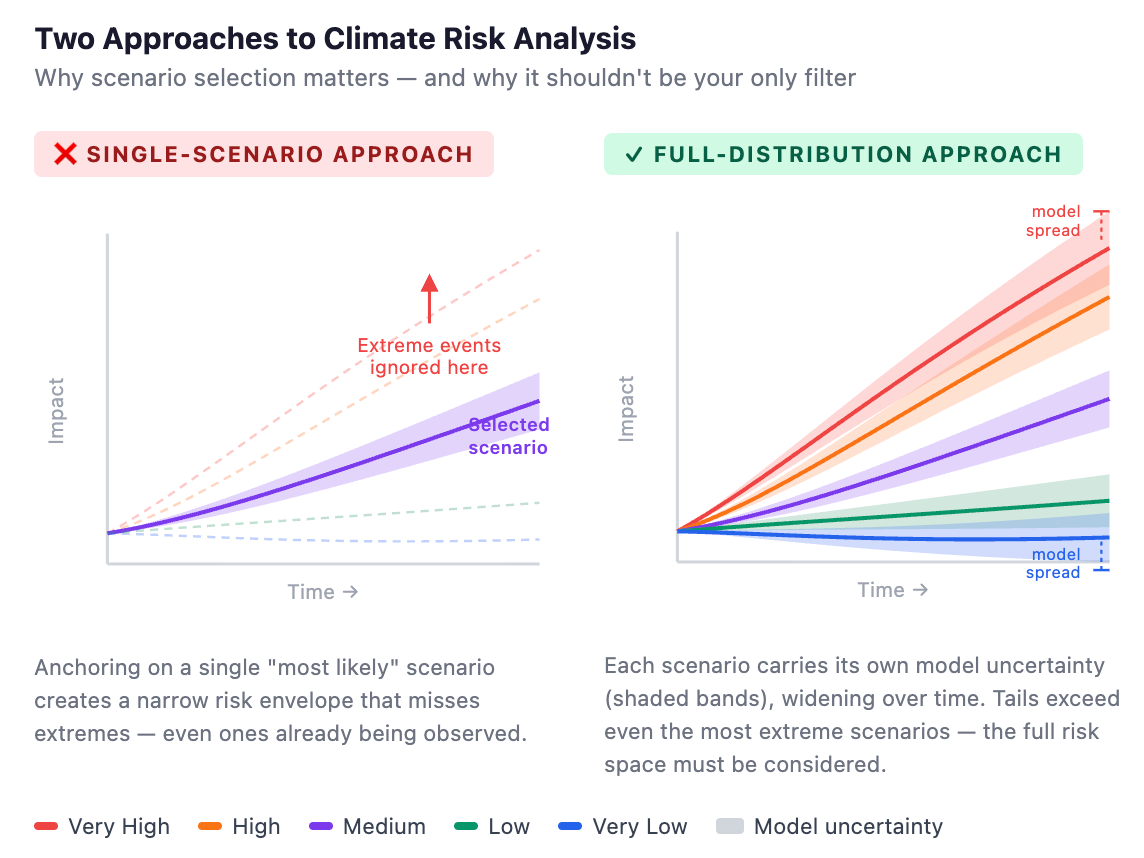
This doesn't mean treating every scenario as equally likely, or generating noise by including simulations without judgment. It means constructing risk metrics that honestly reflect the range of outcomes the science can produce, and communicating that range clearly to decision-makers.
What This Means in Practice
For physical climate risk analysis to be decision-ready, it cannot be hostage to the question of which scenario "wins." Asset managers assessing flood exposure on a 30-year mortgage book, insurers pricing coastal property, and infrastructure operators planning capital maintenance cycles all need to understand the distribution of outcomes - not just the central tendency based on beliefs about the future.
This is especially important as CMIP7 comes into view. The new framework shifts to emissions-driven carbon cycles, which will widen the uncertainty envelope around each scenario. Scenario labels in CMIP7 will be even less informative about impact magnitudes than they were in CMIP6. A risk framework built around scenario selection will become more fragile, not less, as the science advances.
The MIPs were never the problem. The instinct to reduce their richness to a single number - a single scenario, a single model, a single answer - is.
Jupiter's Approach
At Jupiter Intelligence, our physical climate risk metrics are built on bias-corrected and downscaled GCM output that spans the full range of available scenarios and models. We do not select a "preferred" scenario; we construct risk distributions that reflect the genuine uncertainty in climate science and communicate that uncertainty in forms that support real decisions - not false precision.
As CMIP7 matures and its GCM outputs become available, we will incorporate them into our products with the same rigor - but only once we have sufficient understanding of model responses to do so responsibly. Premature adoption of a new model generation is its own form of the scenario trap.
Curious how Jupiter's approach applies to your portfolio or assets? Reach out to our team to learn more.
References and Further Reading
- O'Neill, B.C., et al. (2016). The Scenario Model Intercomparison Project (ScenarioMIP) for CMIP6. Geoscientific Model Development, 9, 3461–3482. https://doi.org/10.5194/gmd-9-3461-2016
- Eyring, V., et al. (2016). Overview of the Coupled Model Intercomparison Project Phase 6 (CMIP6) experimental design and organization. Geoscientific Model Development, 9, 1937–1958. https://doi.org/10.5194/gmd-9-1937-2016
- Hausfather, Z., & Peters, G.P. (2020). Emissions — the 'business as usual' story is misleading. Nature, 577, 618–620. https://doi.org/10.1038/d41586-020-00177-3
- Sherwood, S.C., et al. (2020). An assessment of Earth's climate sensitivity using multiple lines of evidence. Reviews of Geophysics, 58. https://doi.org/10.1029/2019RG000678
- IPCC (2021). Climate Change 2021: The Physical Science Basis. Contribution of Working Group I to the Sixth Assessment Report. Cambridge University Press.
