.webp)

The Tipping Point: What an AMOC Collapse Means for the U.S. Coastline
For millennia, the Atlantic Meridional Overturning Circulation (AMOC) has served as a vital regulator for global climate. Often described as an “oceanic conveyor belt," the AMOC regulates the global climate by transporting warm surface water from the tropical Atlantic northward along the eastern coast of North America. As this water reaches higher latitudes, it cools, becomes denser, and sinks, before flowing back southward along the ocean floor.
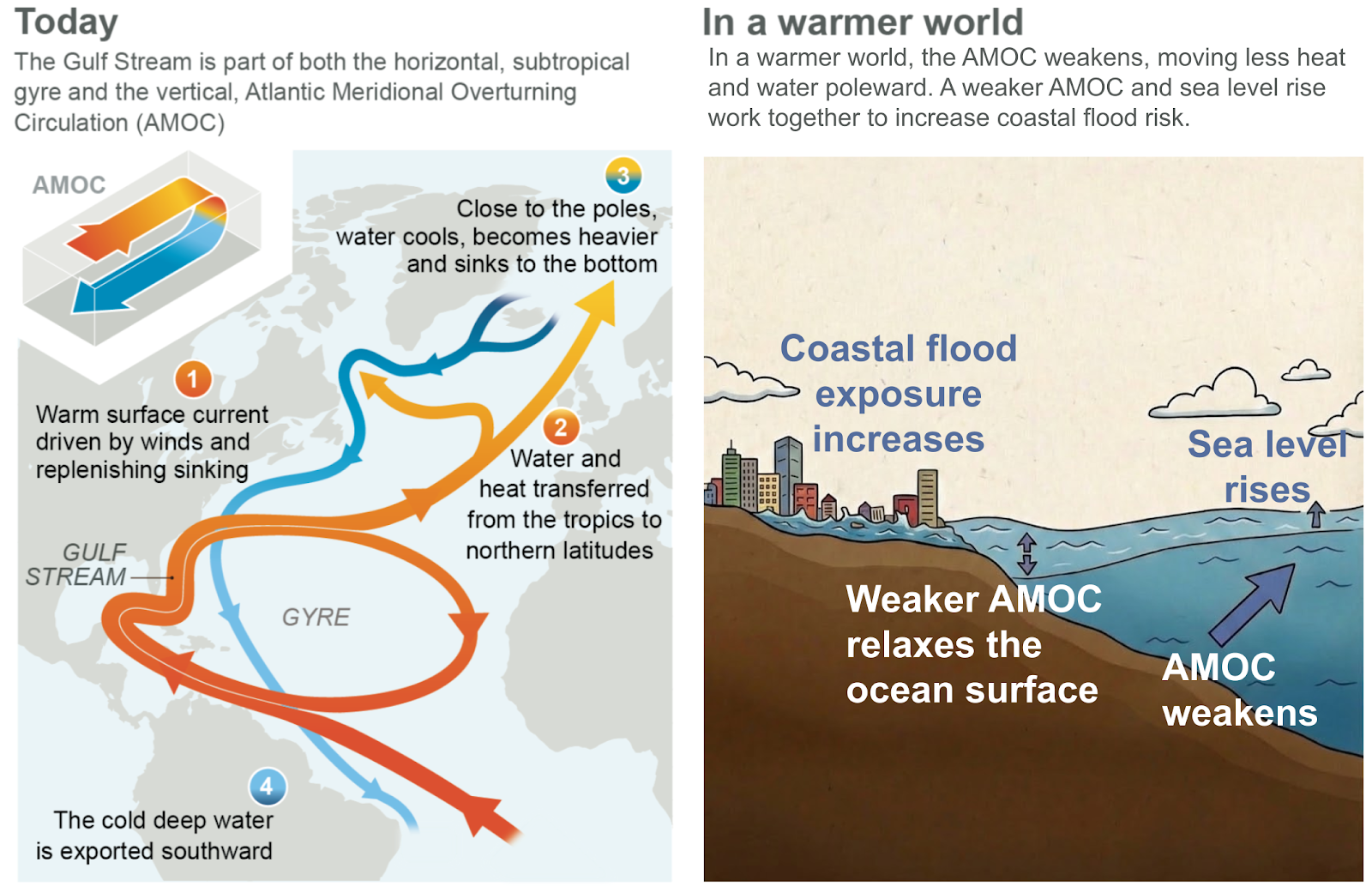
But in recent years, this conveyor belt seems to be slowing down. Driven by a warmer climate and melting ice, the AMOC is currently at its weakest state in at least 1,600 years.
We are accustomed to thinking of climate change as a gradual warming curve. While the scientific community once viewed a complete collapse of this system as a distant, low-probability scenario for the far future, that consensus is shifting rapidly. A growing body of research increasingly suggests that the AMOC is slowing faster than previously thought indicating we may be approaching a point of no return. An abrupt collapse of the AMOC is now considered a possible risk within our lifetimes, with some scientific studies pinpointing a mid-21st-century collapse as not only possible, but likely.
The physical consequences of crossing this critical threshold would be swift, severe, and irreversible on a human timescale. We are no longer just planning for gradual change; we must prepare for a true climate shock.
As AMOC slows, sea levels rise.
If the AMOC collapses, the global climate risk map will be aggressively rewritten. Northern Europe would face a sudden, drastic drop in temperatures – up to 2-3°C per decade in places like the UK and Scandinavia – accompanied by severe drying that would upend agricultural systems and energy demands. Shifts in rainfall would ripple globally, disrupting the Amazon basin and monsoon rains in many regions.
And on the U.S. East Coast, coastal flood risk would rise dramatically. The Gulf Stream, a crucial component of the AMOC, is a fast-moving current that effectively tilts the ocean's surface away from the American shoreline. If this circulation weakens significantly or collapses entirely, that tilting effect vanishes, allowing immense volumes of water to slosh back and accumulate along the eastern seaboard.
This dynamic shift would trigger a rapid and extreme spike in sea levels. A 2050 AMOC collapse is projected to add an estimated 50 centimeters (1.6 feet) or more of sea level rise on top of the baseline increases already expected from greenhouse gas-driven warming, meaning sea level rise on the East Coast could reach nearly 1 meter (3 feet) . This abrupt, non-linear change would dramatically amplify coastal flood hazards, turning rare, catastrophic floods into routine occurrences and pushing the limits of coastal infrastructure.
Quantifying the unthinkable: the economic shock.
To understand the true scale of this threat, Jupiter analyzed the potential economic implications of a 2050 AMOC collapse across a representative U.S. East Coast real estate portfolio encompassing over 16,000 residential and commercial properties valued at $14.1 billion. The findings reveal a landscape of rapidly escalating risk that entirely eclipses standard climate projections.
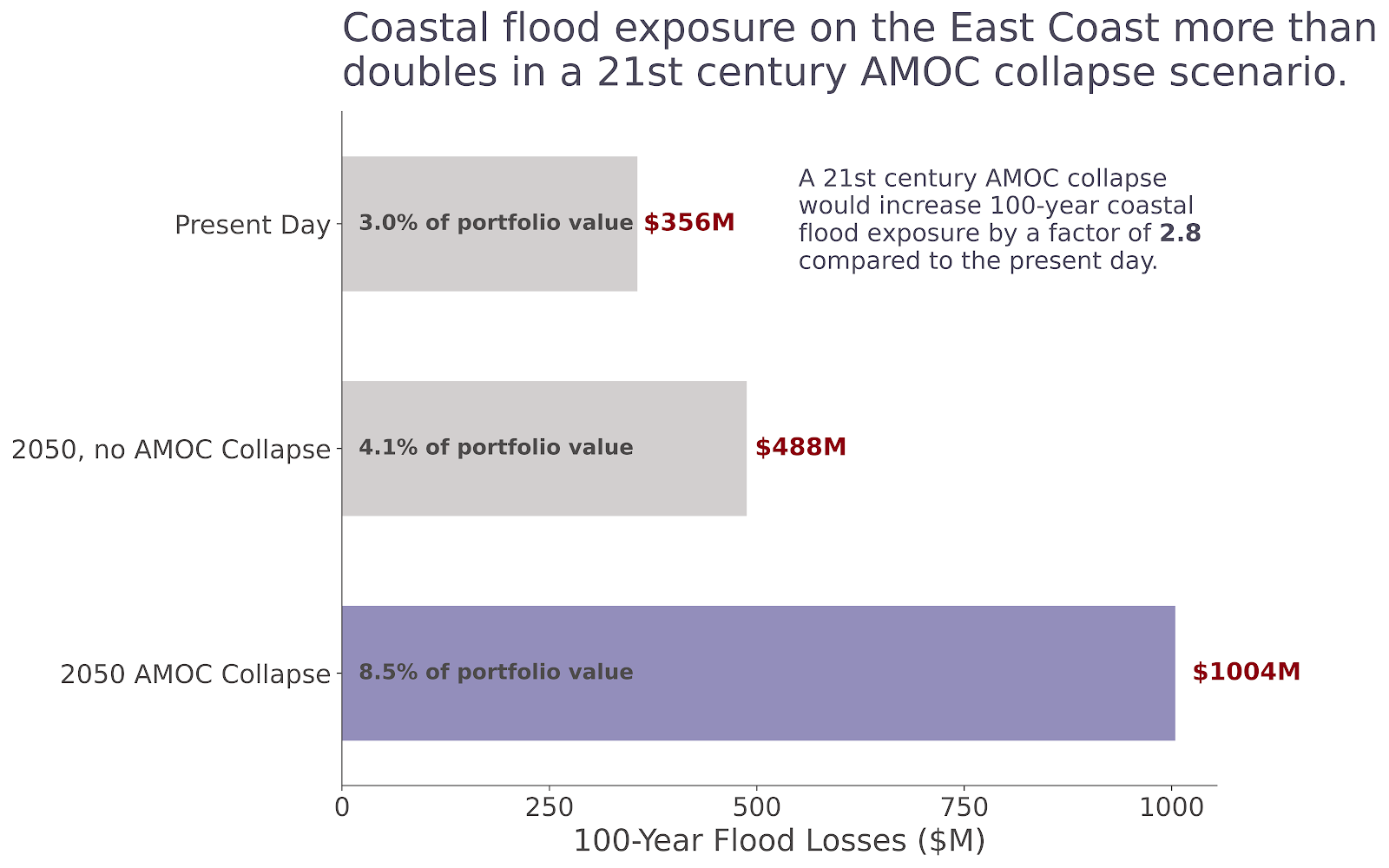
In the event of a 2050 AMOC collapse, exposure to a 100-year coastal flood event across this portfolio increases by a staggering factor of 2.8 relative to present-day risk. This single scenario pushes the financial exposure for these analyzed assets to over $1 billion. When compared to expected 2050 flood risks driven by standard climate change models alone, an AMOC collapse more than doubles the expected flood exposure.
Flood risk doubles in major metro areas: The cost of a 100-year coastal flood event would double in both the Miami and New York City metropolitan areas compared to today. South Florida alone would account for roughly half of the projected East Coast flood exposure in this scenario, with losses soaring to nearly $500 million. In the New York City metro area, flood exposure also more than doubles relative to today, with losses in New York City, and the surrounding areas reaching $270 million following an AMOC collapse.

Sea level rise amplifies destruction from natural disasters: During Hurricane Sandy in 2012, approximately $8 billion of the economic damages in the NYC area were attributed to a mere 10 centimeters of climate-driven sea level rise. A 2050 collapse would raise sea levels by nearly 1 meter (3 feet) relative to today. In South Florida, where over 2 million people already live within 1.2 meters (4 feet) of the local high tide, the combined physical and economic impacts of a direct hurricane hit under post-collapse conditions would be extraordinarily severe.
Emerging Vulnerabilities: This is not just a story of currently risky areas becoming riskier. An AMOC collapse would expand substantial flood exposure into areas that are currently low-risk. We estimate that more than 100 ZIP codes across 12 states that currently face little to no coastal flood risk today will have flood exposure following a 2050 AMOC collapse. Rural areas, estuarine systems, and communities situated along bays will face sudden, heightened risk.
Beyond the floodwaters: the tipping point of financial shock.
These staggering totals illustrate what is at stake if the ocean's conveyor belt grinds to a halt. A 2050 AMOC collapse represents more than just a physical climate tipping point; it is the ultimate catalyst for a systemic financial tipping point.
An event of this magnitude would push natural disasters into entirely uncharted territory. The massive increases in baseline sea level would rapidly alter risk profiles and increase financial volatility, threatening to trigger a cascade of insurance failures. We are already seeing the warning signs: in Florida, homeowners insurance premiums are the highest in the country, nonrenewal rates have skyrocketed by 280% between 2018 and 2023, and one in five homeowners is uninsured. The widespread underinsurance triggered by a full AMOC collapse would undermine mortgage markets, depress real estate values, and hollow out local tax revenues.
But understanding the high-level devastation is only the first step. For financial institutions, real estate investors, asset managers, and corporate planners, the critical imperative is understanding exactly how these large-scale circulation changes propagate down into your asset-level financial exposure. Conventional hazard modeling and backward-looking risk assessments are fundamentally unequipped to capture the non-linear extremes of a climate tipping point.
How do these catastrophic shifts interact with existing vulnerabilities in your specific infrastructure, supply chains, and capital planning? How do you stress test a global portfolio against an unprecedented environmental shock?
The answers require an entirely new framework for evaluating the magnitude and distribution of conditional risk.
The essential blueprint: download the report.
To bridge this crucial knowledge gap, Jupiter has released an essential technical blueprint: an in-depth report detailing the methodology and data behind these AMOC collapse projections.
This comprehensive report moves beyond physical impacts, providing a deep dive into the asset-level financial modeling and strategic imperatives necessary to navigate this emerging threat. It is the definitive guide for translating complex tipping-point science into actionable, forward-looking economic models and adaptation strategies.
The past is no longer a reliable guide to the future. Read the report today to understand how to integrate these critical scenarios into your long-term risk planning and defend your portfolio against the unthinkable.

