.webp)

South Korea finalized one of the most significant sustainability disclosure regimes in Asia — and the clock is already running for the advisory teams who'll help clients get ready.
On July 8, 2026, Korea's Financial Services Commission locked in its roadmap for mandatory climate disclosure under the Korea Sustainability Standards Board (KSSB). The largest KOSPI-listed companies — those with more than KRW 10 trillion in assets, roughly 290 firms — will report starting in 2028, based on fiscal year 2027 data, expanding to more than 3,100 companies in total in 2029, when the threshold drops to KRW 5 trillion.
That means the real work starts now. Companies need their measurement, data, and disclosure processes in place before FY2027 begins on January 1 — not when the first filing deadline arrives in 2028. For advisory teams already building out ESG and climate disclosure practices in Korea, that puts 2026 and 2027 squarely in the client-readiness window.
Why Physical Risk Hits Korea Harder
Korea's disclosure burden falls disproportionately on companies whose value sits in physical assets. Manufacturing accounts for roughly 27% of Korean GDP — more than double the global average of about 12% — and the KOSPI names crossing the KRW 10 trillion threshold first are overwhelmingly manufacturers: semiconductors, autos, steel, shipbuilding, petrochemicals, batteries.
Those assets are concentrated, capital-intensive, and geographically exposed. Steel and petrochemical complexes sit on the coast at Pohang, Gwangyang, Ulsan and Yeosu. Shipyards line the southern seaboard. Semiconductor fabs are water- and cooling-intensive. A single site can carry a double-digit share of a company's output.
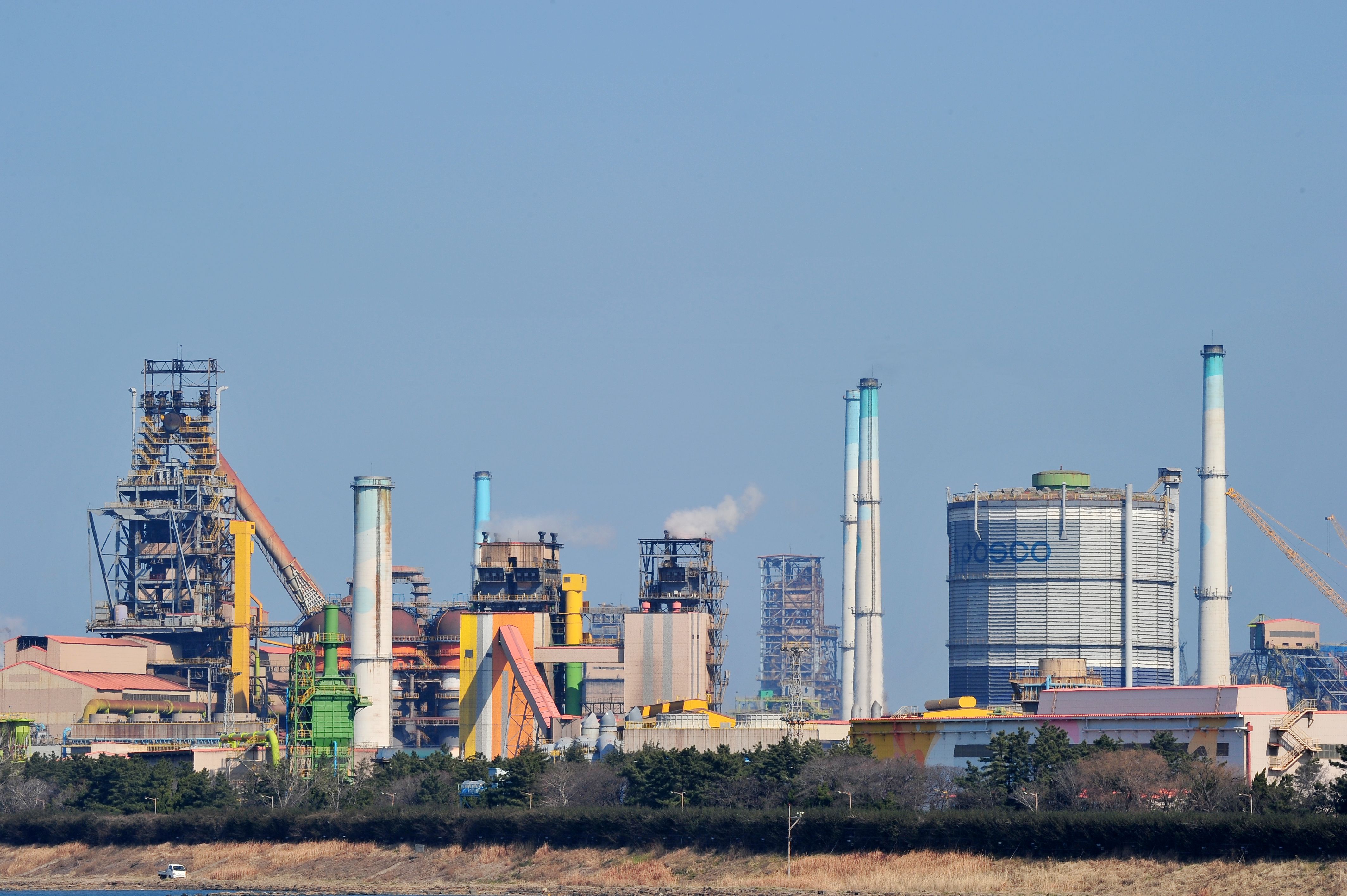
Korea has already seen what that looks like in financial terms. When Typhoon Hinnamnor flooded POSCO's Pohang Steel Works in September 2022, the company projected a sales impact of roughly $1.5 billion and a production loss of 1.7 million tons — more than 10% of the plant's annual crude steel output. In the days that followed, POSCO Holdings shares fell as much as 3.4% in a single session, more than double the KOSPI's decline the same day.
For a disclosure regime built on financial materiality, that is the definition of material. And it is not a risk that can be characterized from a corporate-level narrative: it lives at specific coordinates, under specific hazards, on specific time horizons.
What KSSB actually requires
The standards — KSDS 1 (general requirements) and KSDS 2 (climate) — closely mirror IFRS S1 and S2, which makes them familiar territory for teams already fluent in ISSB-aligned reporting elsewhere. Governance disclosures, transition plans, emissions inventories — most large advisory practices have mature methodologies for these. Physical risk is different, and the specifics are where it gets hard:
- Asset-level exposure, not narrative. The cross-industry metrics require the amount and percentage of assets and business activities vulnerable to climate-related physical risks — a number, disclosed. That means knowing where every owned, leased, and material supplier site sits, and which hazards reach it.
- Multiple hazards, acute and chronic. Acute: typhoon and extreme wind, riverine and surface-water flooding, storm surge, wildfire, hail. Chronic: heat stress, drought and water stress, sea level rise, changing precipitation. Korean industry is exposed on both sides — wind and flood at coastal heavy-industry complexes, heat and water stress at fabs and across inland supply chains.
- Explicit time horizons. Short, medium and long term must be defined by the entity and tied to its planning cycle and the useful life of its assets. For a steel mill, refinery, or fab with a 30-to-50-year life, “long term” is 2050 and beyond — which means hazard exposure has to be modeled to that horizon, not stopped at 2030 because that's where the data got easy.
- Scenario-based resilience. KSDS 2 requires a climate resilience assessment using scenario analysis, with the approach commensurate with the entity's circumstances. In practice, that means results under at least a low-emissions and a high-emissions pathway — SSP1-2.6 and SSP5-8.5 are the common anchors, often with SSP2-4.5 between them — with the scenario source, models, and assumptions disclosed well enough that an auditor can follow them.
That's a specialized data and modeling problem — not an extension of existing disclosure workflows.
.png)
Where the gap shows up
For firms managing KSSB readiness for multinational clients, the pattern tends to look the same: governance and Scope 1/2/3 emissions work is well underway, but the physical risk section of KSDS 2 stalls. Clients ask for hazard exposure by asset and portfolio, quantified financial impact under multiple scenarios, and a methodology that will hold up under regulator and investor scrutiny — and that's a different kind of expertise than most disclosure practices carry in-house.
This is exactly the segment of the workflow where a specialized physical risk data provider is a natural extension of an advisory engagement, not a competitor to it.
Why now, not 2028
The Scope 3 relief built into the roadmap (a three-year deferral) buys time on emissions accounting. There's no equivalent grace period for physical risk data readiness — companies still need defensible exposure and impact analysis for their first FY2027 disclosures. Waiting until closer to the 2028 filing deadline to sort out physical risk methodology means compressing a data-intensive workstream into a much smaller window, right when disclosure teams are also finalizing everything else.
Korea also isn't an isolated case. It joins Japan, Australia, Singapore, and the Philippines in a broader Asia-Pacific shift toward mandatory, ISSB-aligned disclosure — a trend running in the opposite direction from recent moves in the EU and US. For any advisory practice building out a regional sustainability disclosure capability, Korea is one piece of a larger, recurring need.
What a defensible physical risk disclosure contains
A quick scoping checklist — useful for advisors sizing a KSSB physical risk engagement:
- Asset register with coordinates — owned, leased, and material supplier sites
- Hazard set covering both acute and chronic risk
- Time horizons matched to asset life, not a default cutoff
- At least two emissions scenarios, sourced and documented
- Financial translation — damage, downtime, and value at risk, not just a hazard score
- Documented methodology and data provenance an auditor can follow
Where Jupiter comes in
Jupiter works with advisory and audit firms already serving KOSPI-listed and multinational clients on the physical risk piece of climate disclosure — transparent, scenario-based analytics that quantify exposure and financial impact at the asset, entity, and portfolio level, built to hold up under board, regulator, and investor scrutiny.
If your team is thinking about it or already scoping KSSB readiness for clients, we'd welcome a conversation about how physical risk data fits into that work — well before the 2027 crunch begins. Contact a climate expert here.
