.webp)
.png)
.png)
Jupiter customers and prospects frequently ask us about AI in our climate risk intelligence.
The honest answer is that we didn't wake up one day and decide to bolt “AI-powered” onto our marketing. We've been building AI and machine learning into our climate risk stack since 2018 because it was the right tool for a specific set of hard problems.
That distinction matters more than ever. Climate risk analytics live at the intersection of physical science and financial decision-making. Get the science wrong, or hide it inside a black box, and you don't just produce a bad chart. Instead you may produce a mispriced mortgage, an underinsured asset, or a credit rating that misses a material risk.
So the question we ask before adopting any AI technique isn't “can we use this?” It's “does this make our science faster, cheaper, or more accurate without making it less explainable?” And in support of our banking customers, “will this compromise our models’ success in passing Model Risk Management assessments?”
Here's how that's played out.
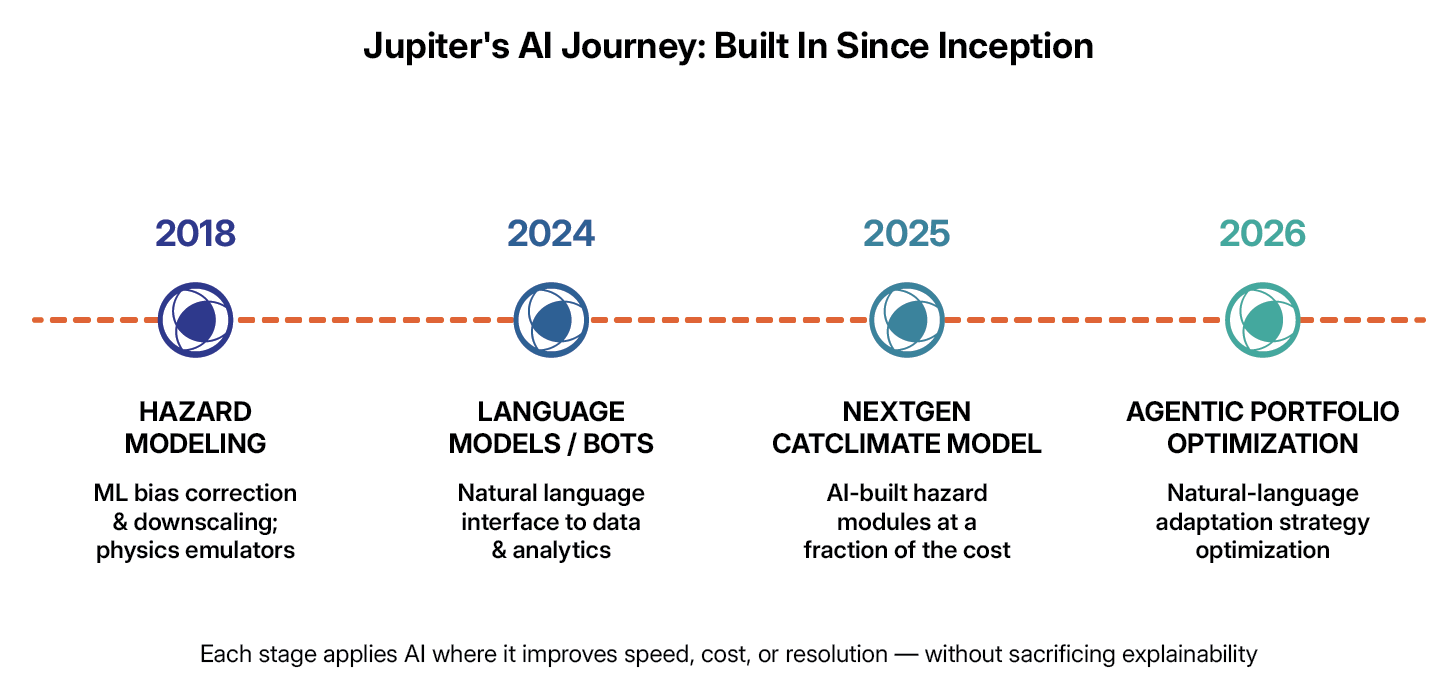
2018: ML as the engine, not the storefront
Our earliest use of machine learning was quiet and unglamorous. We use supervised learning for bias correction and downscaling by taking coarse, global climate model output and refining it to the resolution needed to understand risk to an individual building or asset. We pair that with physics emulators: machine-learned approximations of expensive physical simulations that let us model multiple hazards — flood, wind, heat, wildfire, drought, hail, cold, subsidence, precipitation — without needing a supercomputer's worth of compute for every run. All calculations are transparent and reproducible. The results are always checked against the physical science it was standing in for.
To be fair, many of these ML algorithms have in the past been labeled as AI. Now, AI is usually associated with generative algorithms. Those don’t apply here.
2024: Making the data speak plainly
As large language models matured, we saw a genuine opportunity: not to generate answers, but to make it dramatically easier for a risk analyst to ask a question in plain English and get back a grounded answer from our existing, validated analytics. Natural language interfaces to data and analytics sound like a small thing, but they collapse the distance between “the model has an answer” and “the person who needs it can actually get to it.” The bar we hold ourselves to here is that the language model is a conduit to vetted data, not a source of new facts.
2025: NextGen CatClimate — AI in service of the physics
This is where AI has had its biggest impact on our science itself. Our NextGen CatClimate Model uses AI to build and maintain global, multi-peril hazard modules at a fraction of the traditional cost and to apply them in any climate without the posterior tuning that typically limits how portable a hazard model is.
NextGen is a single modeling stack for event-based global hazards, current and future, fully connected to our exposure, vulnerability, and financial modules. That single stack captures spatial and temporal correlations that siloed, peril-by-peril models miss. For example, a hurricane and a heat wave compounding during an ongoing drought, or tropical cyclones striking on opposite sides of the world in the same season. It also captures multi-annual and interannual predictability by conditioning on modes like El Niño and the Pacific Decadal Oscillation, rather than treating every year as an independent roll of the dice.
The output is tens of thousands of years of simulated, high-resolution global weather including large ensembles of storm tracks, multi-day heatwave events, and more. All reproducing real historical global temperature patterns and variability. That's the kind of dataset that used to require either enormous compute budgets or years of model development. AI is what makes producing it fast and inexpensive enough to keep pace with how quickly the climate itself is changing.
2026: Agentic tools, tested carefully
Our newest frontier is agentic portfolio optimization in the context of rapid-build applications that let a user pose a real business problem in natural language. Something like asking the system to optimize an adaptation strategy under a fixed spending cap, and get back a structured, defensible answer. We're deliberately calling this “testing,” not yet “shipping broadly,” because agentic AI making recommendations about capital allocation carries a different risk profile than AI that downscales a temperature grid. It earns wider deployment as we validate it, not before.
Preventing bias and hallucination: no black boxes
Everything above sits underneath a governance commitment we don't compromise on. Every model we build is explainable, traceable, and audit-ready. We maintain extensive technical documentation and independently co-developed validation test suites specifically so that a skeptical model-risk reviewer can evaluate exactly how a result was produced. AI can make a model faster or cheaper to build but it never gets to make a model harder to explain. Along the way, we ensure our core products for banks are free of AI that can deliver non-reproducible or non-auditable results. Customers may opt-in, instead of needing to opt-out.
That's the throughline across eight years of AI adoption. Jupiter uses machine learning and AI where it measurably improves speed, cost, resolution, bias correction, physics emulation, hazard simulation, natural language access, and agentic workflows. We never let it compromise the transparency that decision-grade financial analytics require. AI is a tool we reach for deliberately, in specific places, for specific reasons.
Stay tuned for a Model Context Protocol (MCP) Connector, which will let you access the Jupiter platform from your favorite AI application. Coming this fall.
Want to understand how Jupiter uses AI to support your risk decisions? Talk with our team about the science, validation, and applications behind our climate risk intelligence.
About the author:
Dr. Josh Hacker, Chief Science Officer and Co-founder of Jupiter, is an atmospheric scientist with a broad research and science management career, focusing on lower atmosphere prediction and predictability across many time and space scales. He is an expert in weather and climate applications for the Department of Defense (DoD) and the National Oceanic and Atmospheric Administration (NOAA). Along with university partners, Dr. Hacker led the containerization work in the Big Weather Web project funded by the National Science Foundation (NSF). He is also a pioneer in deploying atmospheric simulations in the cloud. Prior to his work at Jupiter, Dr. Hacker’s experience spanned laboratory and university settings. Extensive work for the National Center for Atmospheric Research (NCAR) included stints as Director, Joint Numerical Testbed Program, Research Applications Laboratory; and Deputy Director, National Security Applications Program, Research Applications Lab.
