.webp)

Physical climate risk is no longer theoretical—it is reshaping financial performance. As institutions move beyond disclosure toward action, adaptation finance provides the framework to translate forward-looking risk into capital decisions. By linking climate analytics with financial metrics, organizations can prioritize resilience investments, quantify avoided losses, and integrate adaptation into core capital strategy.
Physical climate risk has moved from abstract modeling to financial reality.
Asset damage. Business interruption. Rising insurance costs. Repricing of risk in vulnerable regions. These are no longer theoretical projections. They are recurring features of balance sheets.
The economic case for adaptation is increasingly clear: studies estimate that every $1 invested in adaptation generates between $2 and $12 in economic benefits through avoided losses and improved productivity.
Over the past decade, advances in climate science and analytics made physical risk visible. Institutions gained clarity about where assets were exposed and how hazards might evolve.
That visibility was essential. But today, exposure awareness is no longer the central question. The question is how capital should respond.
Physical risk is now a structural financial input
Across markets, capital is already adjusting. Yet many of these shifts remain reactive. Decisions are often made asset by asset, region by region, without a consistent framework for comparing risk or prioritizing intervention.
As physical climate risk becomes a structural driver of financial performance, institutions face a more demanding challenge:
How do you translate forward-looking risk into defensible capital decisions? That is the domain of adaptation finance.
Reframing adaptation as a capital and risk management problem
Adaptation is often discussed as an engineering or sustainability challenge. In that framing, it is associated with physical interventions: flood defenses, cooling systems, asset hardening, or infrastructure upgrades. What’s missing is how decisions about these measures are actually made.
For banks, insurers, and asset managers, adaptation is fundamentally a capital discipline question.
It influences expected loss, volatility, insurability, asset valuation, underwriting appetite, and portfolio concentration. It affects return assumptions and downside protection. It determines which assets remain viable and which may require managed exit.
Capital, however, only moves when trade-offs are clear.
To justify adaptation investment, institutions must answer three questions:
- Where is risk financially material?
- Which interventions meaningfully reduce exposure?
- When does investment improve risk-adjusted outcomes?
Without structured, finance-linked analysis, adaptation remains conceptual rather than operational.
The gap between risk insight and capital action
Disclosure frameworks including CSRD, TCFD, and ISSB advanced the conversation around physical climate risk. They forced institutions to identify exposures and surface vulnerabilities.
Disclosure created visibility. For many organizations, disclosure requirements created the first enterprise-wide view of how physical hazards intersect with assets, portfolios, and counterparties.
It did not, however, define how capital should respond.
Many disclosure frameworks rely on aggregated national scenarios or global damage functions that lack the asset-level granularity needed for financial decision-making, leaving institutions with risk visibility but limited guidance on how to allocate capital.
Many institutions now find themselves in assessment mode — able to describe exposure in detail, yet lacking the structure to prioritize action, compare interventions, or defend capital allocation decisions under scrutiny.
Boards and regulators are asking harder questions:
- How is this risk being managed?
- How will losses be reduced?
- How does capital allocation reflect these exposures?
Answering those questions requires more than hazard maps and portfolio heatmaps. It requires a framework that aligns physical risk with financial logic.
From risk recognition to capital deployment
The adaptation decision journey reflects how financial institutions already move from information to action. It reframes adaptation as an evolution of established financial logic — not a parallel sustainability workflow.
The journey unfolds in three stages: assess, evaluate, decide.
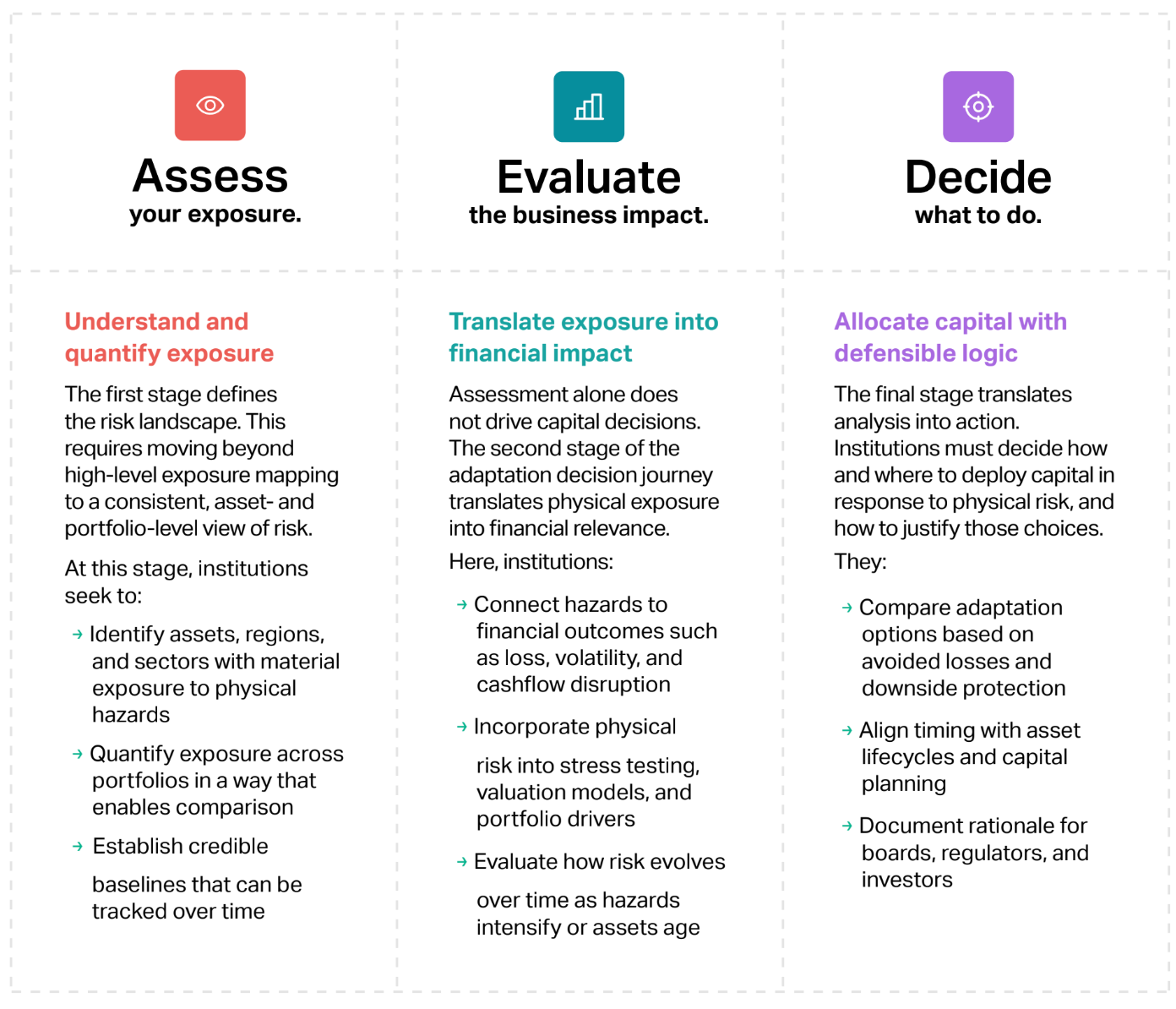
When supported by decision-grade analytics, this process allows adaptation to be evaluated like any other capital project. Avoided loss, ROI, timing, and downside protection become measurable and comparable.
In one example explored in Adaptation finance: Turning physical risk into capital decisions, a coastal distribution facility remains within internal risk tolerance through the 2030s. Around 2040, projected flood losses cross a financial threshold. Modeling a targeted intervention at that inflection point yields a quantified avoided loss of $1.68M and a modeled 30% ROI.
Why this matters now
The scale of the challenge is enormous. Estimates suggest that the global cost of inaction on climate adaptation could reach $1,266 trillion between 2025 and 2100, underscoring the financial urgency of translating risk insights into investment decisions.
Insurance repricing is accelerating. Asset durability assumptions are shifting. Supervisory scrutiny is increasing. Capital providers increasingly expect evidence that physical risk is actively managed — not simply disclosed.
Institutions that can quantify avoided loss and compare resilience measures using consistent financial metrics gain a structural advantage.
- They move earlier.
- They allocate capital with greater confidence.
- They protect value before repricing becomes punitive.
Those that cannot risk remaining reactive, making fragmented decisions under increasing pressure.
Adaptation finance: Turning physical climate risk into capital decisions
Our latest eBook examines:
- Why physical climate risk is becoming a structural driver of financial performance
- Why disclosure alone is no longer sufficient
- How adaptation can be reframed as a capital discipline
- What “decision-grade” analytics means in practice
- How institutions can move from risk visibility to defensible capital deployment
Download Adaptation finance: Turning physical climate risk into capital decisions to explore how forward-looking, finance-linked analytics enable institutions to turn resilience into a repeatable component of capital planning.

